
ARGELLAN / KRIL
KRIL
Keep the original. Understand every version.
KRIL is ARGELLAN’s document-management and information-custody system. It connects exact source material, immutable document versions, processing history and records decisions so a user can understand what a document is, how it changed and which interpretation is being reviewed.
For teams responsible for documents and their history
KRIL is for analysts, document custodians and records administrators who need more than a folder location. It is designed around the difference between an original, a later version and a derived interpretation such as OCR text.
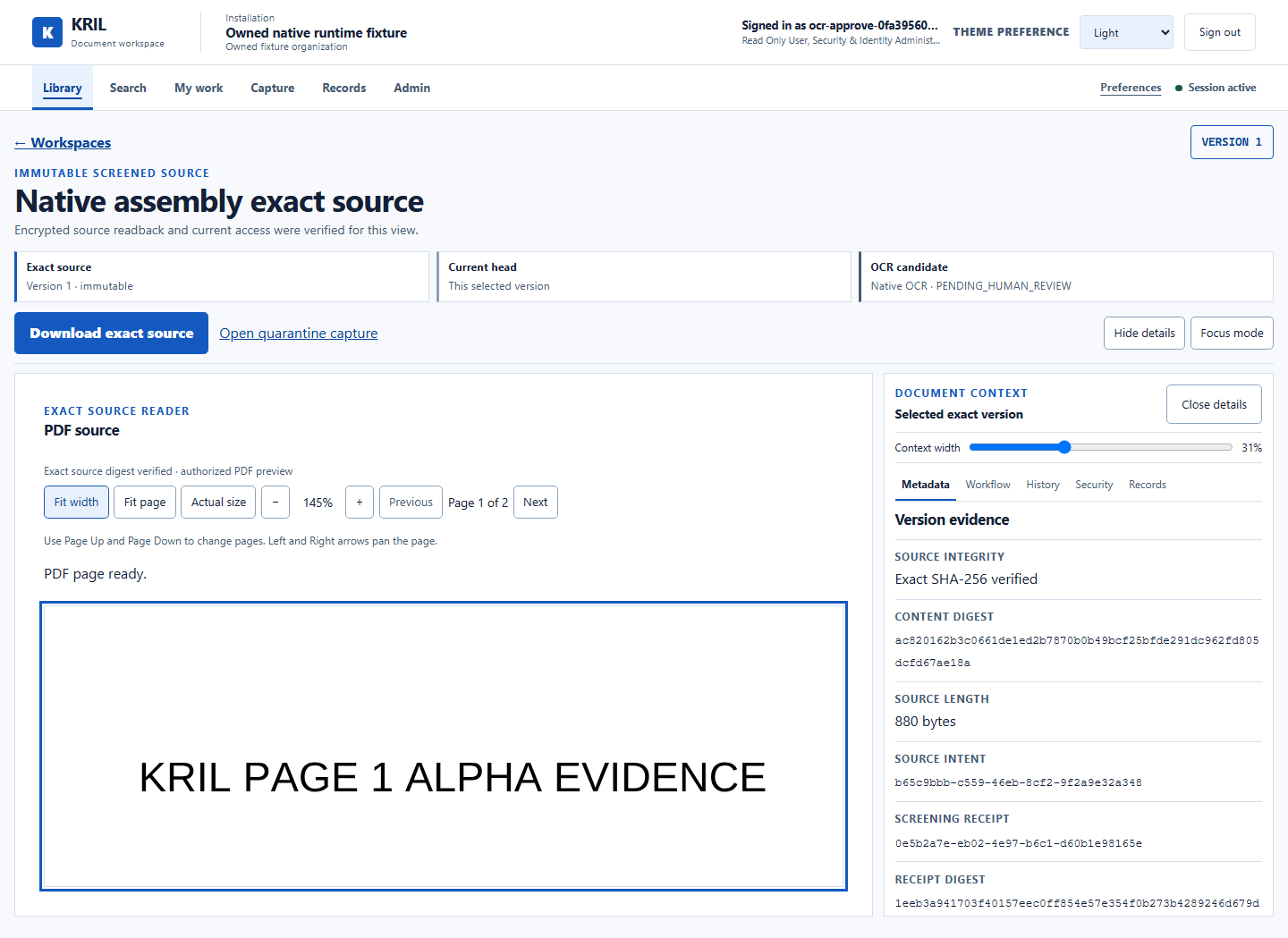
The Reader, version history and Records workflows bring those relationships into the user’s work. An extracted candidate remains a candidate until the appropriate review decision is made; successful processing alone does not approve the content.
From intake to an accountable record
Receive or author
Bring material through the configured intake path or create a native document. Intake records the source and completion identity; ambiguous or unsafe material stays in a held or quarantine state.
Preserve the exact source
KRIL binds original bytes to document and version identities. Later versions retain their own metadata and source relationships instead of replacing historical evidence.
Process and review
A processing worker reads the bound source and returns a derived candidate. In the OCR workflow, the original PDF and pending OCR interpretation stay distinct for review.
Retrieve and manage
Authorized users inspect the document, compare versions and work with Records decisions. Current policy and document state govern the requested action.
Document and records capabilities
| Immutable versions | Exact source bytes and reconstructable metadata snapshots identify each version. |
|---|---|
| Native authoring | Create and revise native Markdown documents with explicit source representation. |
| Version history and comparison | Inspect earlier versions, download exact source and compare selected versions. |
| Concurrent editing | A stale draft is preserved when another writer has advanced the document head. |
| OCR review | Processing provenance and pending candidates keep extracted text separate from approved content. |
| Document Reader | PDF viewing with fit-width and actual-size behavior in the Reader interface. |
| Records workflows | Retention and disposition work is tied to explicit records decisions and authority. |
| Audit and access | Scoped identities, workspaces, request correlation and durable records of admitted and denied actions. |
Inputs and outputs
The source includes native document authoring, file intake, watched-folder and scanner-related paths. Those paths have different installation and device-qualification states. The first evaluation should identify the document formats, acquisition route and processing environment you actually need.
KRIL produces bound originals, version records, processing lineage, review candidates and authorized document views. Records and audit information explain the decisions around the content. OCR output is a derived artifact, not a replacement for the source document.
Technical profile and deployment discussion
| Application architecture | A modular backend with separate processing workers and a browser User/Admin interface. |
|---|---|
| Backend and database | Python 3.12 and FastAPI with PostgreSQL for canonical structured state in the reference stack. |
| Frontend | React and TypeScript; Node.js 24 is the declared build-tool runtime in the reference stack. |
| Document processing | PDF.js for browser reading; PDFium, Tesseract, Pillow and ZXing in the processing stack. |
| Source storage | Encrypted-source mechanisms bind stored material to exact identities and receipts. Key custody and recovery are part of installation qualification. |
| Deployment arrangement | Application services and processing workers can occupy separate hosts. Scanner and OCR dependencies must match the selected acquisition path. |
| Integration boundary | KRIL’s current V1 direction is standalone. CORE and the shared Security Engine are not mandatory runtime dependencies; the proposed ONTAREN bridge is a separate integration. |
| Evaluation status | KRIL is under active qualification. A scoped evaluation should define required intake, review, retrieval and recovery workflows before operational acceptance. |
Questions about KRIL
Does OCR overwrite the original?
No. The original and its immutable identity remain separate from the OCR candidate and processing history. Review determines how the derived text may be used.
Can I compare and retrieve older versions?
The implemented version workflow provides bounded history, exact-source download and comparison. Each version retains its own identity and metadata.
Does KRIL require ONTAREN or Security Engine?
The current V1 direction is standalone. ONTAREN knowledge publishing and optional shared-platform integrations are separate scopes.
Will my scanner work with KRIL?
Scanner support must be checked against the exact device, acquisition software and document workflow. Existing adapter and synthetic results do not establish support for every physical scanner.
What should an evaluation cover?
Identify the document types, security domains, intake sources, review roles, retention requirements and recovery expectations. These determine which implemented paths and remaining qualification work matter to your deployment.
Define a document workflow you can account for.
Tell us what you need to accomplish, the environment you operate and the constraints that matter.
Discuss KRILOpens your email application. No message is submitted by this website.