
ARGELLAN / OVERWATCH
OVERWATCH
An operating picture with the evidence behind it.
OVERWATCH is ARGELLAN’s intelligence and mission decision-support platform. It brings receiver observations and configured feeds into a persistent operating picture, preserving source, time, freshness and uncertainty as information moves from collection to inspection.
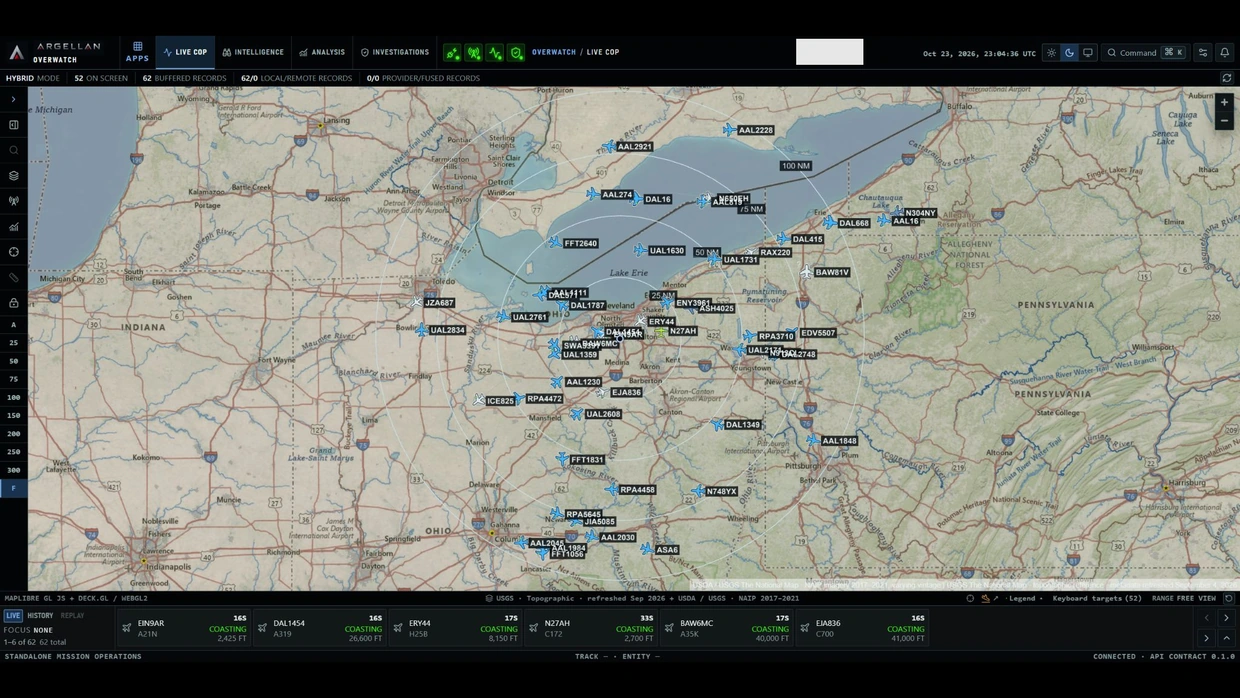
Multi-source air intelligence, track history and an integrated operating picture.
Source details
OVERWATCH Map View · 23 October 2026 · Historical civilian-air data. Basemap credits: USGS The National Map / USDA NAIP 2017–2021.
For analysts operators and mission-system teams
OVERWATCH supports work that begins with changing observations and requires more than a symbol on a map. An operator can inspect where a record came from, how old it is, what identity information is available and which conclusions remain unresolved.
The implemented platform includes targeting and fire-control modules. These support mission-specific workflows alongside the broader collection and analysis system. The module set, interfaces and deployment state are addressed in a program-specific technical discussion.
From collection to a reviewed operating picture
Collect and retain the observation
Configured adapters receive source data. The ingestion path preserves source identity, available source time and observation meaning before admitted records enter durable storage.
Build the operational view
Authenticated application services provide bounded projections to the browser. The operating picture distinguishes local and remote records and exposes freshness and collection health.
Inspect the evidence
Select a track or record to examine context in the Inspector. Registration, operator, registered owner, type and manufacturer remain separate claims; unresolved identity stays unresolved.
Examine the recorded sequence
Use History to inspect original observations and their ordering. Historical information retains its original source and time rather than inheriting a later label as if it had always been known.
Capabilities
| Operational map | A persistent air picture with source and freshness context, selectable records and an Inspector. |
|---|---|
| Track and Entity views | Observed tracks and persistent entities remain distinct; unavailable associations are disclosed. |
| Receiver ingestion | Documented local 1090 MHz and UAT observation paths with durable storage. |
| History | Bounded pages of original records with stable ordering and source timestamps. |
| Reference context | Separate identity claims and visible conflicts or missing values. |
| Collection adapters | Defined interfaces for bringing configured sources into governed ingestion. |
| Targeting and fire control | Built specialist modules for program-specific mission workflows; deployment and integration scope are established for the selected environment. |
What enters and what the operator receives
The demonstrated collection foundation uses local aircraft receiver data, including readsb-based 1090 MHz observations and UAT inputs. Additional feeds depend on the relevant adapter, provider access and active configuration. A feed being supported in code does not mean it is collecting in a particular installation.
The operator receives an authenticated operating picture, record details, historical observations and identity context. Targeting and fire-control modules add specialist mission workflows, with technical scope defined against the program’s requirements.
Technical profile and deployment discussion
| Backend | Python/FastAPI mission API with PostgreSQL-based durable state. |
|---|---|
| Browser delivery | Static frontend and server-side Node gateway in the operational architecture. |
| Map rendering | MapLibre and deck.gl rendering components with a typed render-data boundary. |
| Collection hosts | Receiver and adapter processes are separate from the browser; source access and custody are configured per path. |
| Provider connections | Local receiver paths are documented. Provider feeds require their own access and enablement; OpenSky was disabled at the last cited installation check. |
| Installation scope | Private application, API, database and collection services with authenticated access. Host sizing follows the chosen sources, retention and module scope. |
| Workflow selection | Confirm the installed source set and required workflows. Investigations is undergoing further functional verification. |
Questions about OVERWATCH
Is OVERWATCH only an aircraft map?
No. The operating picture is the visible collection foundation of a broader intelligence and mission-support platform. The built module set includes targeting and fire control, with program-specific deployment and integration scope.
Does a displayed track establish a confirmed identity?
A track is an observation-based representation. Persistent Entity linkage and individual identity claims are separate. Missing or conflicting evidence remains visible.
Which feeds are active?
That depends on the installation. Local 1090 MHz and UAT ingestion are documented; external providers require the appropriate access, adapter and enablement. We review the required source list as part of the deployment discussion.
Can I review earlier observations?
History exposes recorded observations in bounded, ordered pages. The available period depends on retained data and the selected installation.
How do we discuss targeting or fire-control requirements?
Start with the program purpose, authorized scope and required system interfaces. ARGELLAN can review the relevant built modules and their deployment state at the capability and workflow level.
Define the picture and mission workflow you need.
Tell us what you need to accomplish, the environment you operate and the constraints that matter.
Discuss OVERWATCHOpens your email application. No message is submitted by this website.